



Blog
Why Does Perfume Smell Different After a Few Hours?

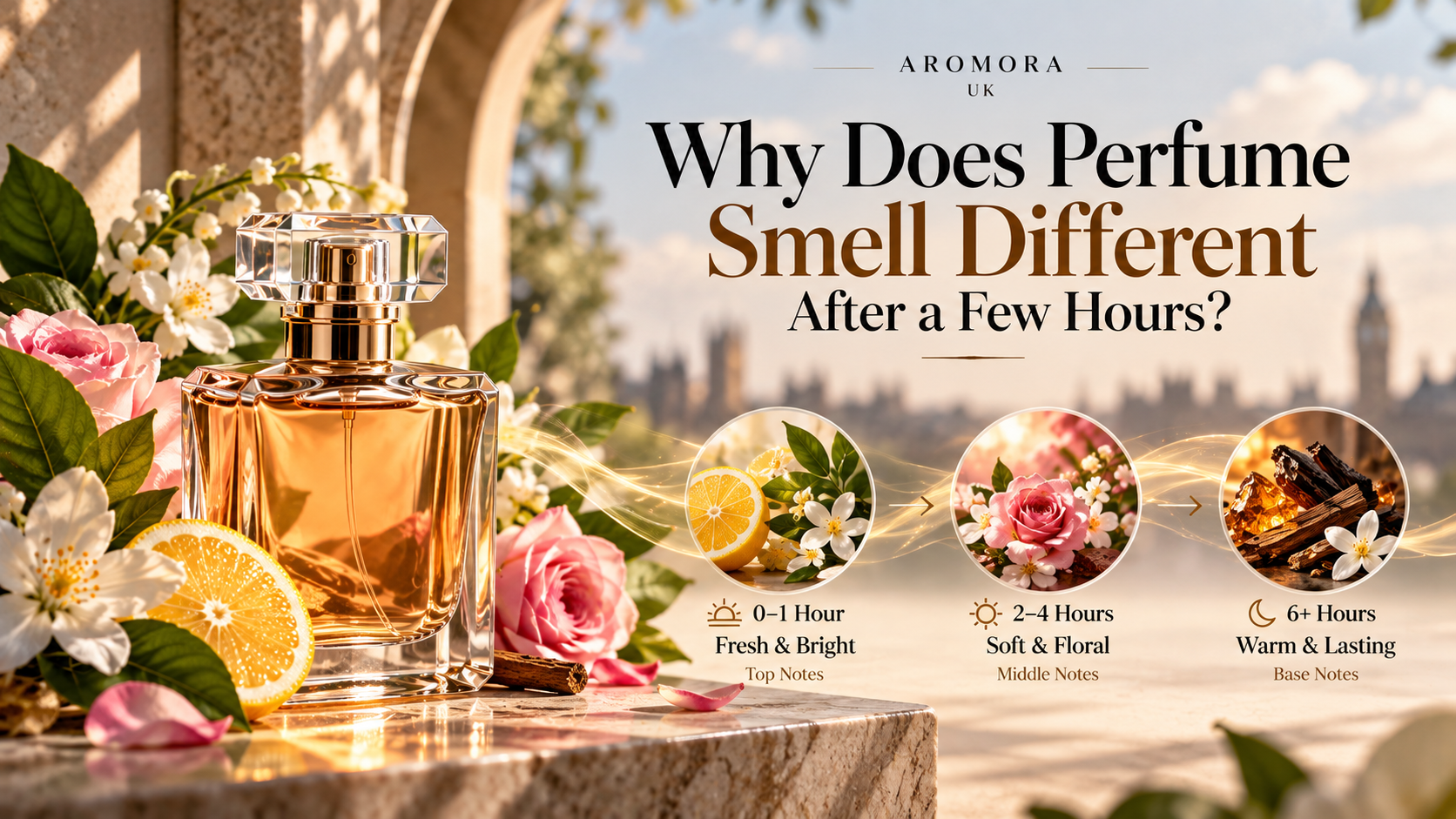
Have you ever put on your favourite perfume in the morning, only to notice that it smells quite different a few hours later? The fresh, citrus scent you enjoyed at first might become softer, sweeter or more woody by lunchtime. This change is usually a normal part of wearing perfume. Different ingredients develop at different rates, while your skin, the weather and even your sense of smell can affect the fragrance you notice.
At Aromora, understanding how a fragrance changes throughout the day can help you choose a perfume that suits your taste and routine. Whether you enjoy light floral scents, fresh citrus fragrances or deeper woody perfumes, it is worth discovering how a scent develops after the first spray. This can help you make a more informed choice when trying a new fragrance.
So, Why Perfume Smells Different after a few hours comes down to how its ingredients behave over time. The lighter parts of a fragrance may become less noticeable, allowing other notes to stand out. This change is often called fragrance evolution, and it explains why the same perfume can give you a different experience in the morning and later in the day.
How Does Perfume Change Its Smell Over Time?
A perfume contains a blend of aromatic ingredients, and each one contributes something different to the overall scent. Some ingredients are easier to notice straight after application, while others become more apparent as time passes.
Think about a perfume that opens with lemon or bergamot. At first, it might smell bright, clean and refreshing. After a while, floral, fruity or spicy notes may become easier to notice. Later, the fragrance could take on a warmer character, with hints of vanilla, musk, amber or wood.
This is a simple example of how perfume scent changes over time. The fragrance itself has not necessarily changed in quality. Instead, the balance of scents you notice has shifted as different ingredients become more or less noticeable.
Three things help explain this process:
- Evaporation: Some fragrance ingredients evaporate more readily than others, so their scent may fade sooner.
- The perfume formula: The ingredients used and the amounts of each ingredient affect how the fragrance develops.
- Your sense of smell: Your surroundings, sensitivity to certain scents and familiarity with the perfume can influence what you notice.
For example, one fragrance might begin with a sharp citrus scent and gradually become soft and woody. Another may keep its fresh character for longer before developing a deeper smell. Neither pattern is unusual. Every perfume has its own formula, so its development will not be exactly the same as another fragrance.
Does Every Perfume Change in the Same Way?
No. Some perfumes have a clear difference between their opening and later scent, while others stay fairly similar for several hours.
Fresh citrus and light aromatic fragrances may have a bright opening. Woody, musky and amber fragrances can have a warmer or deeper character, although their openings may still be fresh or light. The fragrance family alone does not tell you exactly how a perfume will smell later.
The best way to find out is to wear the perfume on your skin and give it time to develop. The first few minutes tell you about the opening, but the scent after an hour or two can give you a better picture of the fragrance as a whole.
Perfume Top, Middle and Base Notes Explained
Perfumes are often described through three types of notes: top notes, middle notes and base notes. These terms make it easier to understand the different parts of a fragrance and how they contribute to its overall character.
Understanding perfume top middle and base notes can also help you choose a scent more carefully. Instead of deciding based only on the first spray, you can pay attention to how the fragrance changes as you wear it.
1. Top Notes: The First Impression
Top notes are the scents you usually notice first after applying perfume. They often give a fragrance its bright, fresh or lively opening.
Common examples include:
- Bergamot and lemon
- Mandarin and other citrus notes
- Fresh herbs
- Light aromatic ingredients
Many top notes are relatively volatile, which means they can become less noticeable sooner than some other ingredients. This is why a perfume may smell strongly of citrus at first but seem softer after a short time.
Imagine spraying a fragrance with lemon and bergamot. Its opening might feel crisp and refreshing, making a strong first impression. As the fragrance develops, those citrus notes may become less prominent and other parts of the formula may stand out.
Top notes play an important role because they shape your first experience of a perfume. However, they do not always tell you whether you will enjoy wearing the fragrance for the rest of the day.
2. Middle Notes: The Heart of the Fragrance
Middle notes are also known as heart notes. They help give a perfume its main character as the opening develops.
Some common middle notes are:
- Rose and jasmine
- Lavender
- Cardamom and other spices
- Fruity and aromatic notes
A fragrance that begins with fresh citrus may later feel more floral, spicy or smooth. Another perfume might combine its fresh opening with warm spices, creating a different impression after some time.
These changes do not mean that a new scent has been added. They happen because the ingredients in the original formula become noticeable in different ways as the fragrance develops.
The heart of a perfume is worth paying attention to when choosing a fragrance. You might love a perfume’s fresh opening but find that its floral or spicy character is not quite right for you. Testing it for a little longer can help you decide whether the full scent suits your taste.
3. Base Notes: The Deeper, Lasting Scent
Base notes often help shape the later stages of a fragrance. They can give a perfume a warmer, deeper or softer character and contribute to the impression it leaves behind.
Common base notes include:
- Vanilla
- Sandalwood and cedarwood
- Musk
- Amber accords
- Patchouli
These ingredients can play a part in how long a fragrance remains noticeable. However, no single ingredient guarantees that a perfume will last all day. The complete formula, including the way its ingredients work together, matters.
For instance, a perfume may open with bright citrus before becoming more woody or musky. Another may seem sweeter later on as vanilla becomes more noticeable. This is one reason the fragrance you notice in the evening may feel quite different from the one you sprayed in the morning.
The important thing to remember is that a perfume deserves more than a quick test. Its opening, heart and later scent can each contribute something different to the experience.
Why Perfume Smells Different on Skin
Have you ever tried a perfume that smelled lovely on someone else but seemed different when you wore it? This happens quite often. The same fragrance can create slightly different impressions on different people.
Skin moisture, temperature and the way you perceive smells can all influence your experience. The perfume’s formula also plays a major part in how it develops.
Skin Moisture and Natural Oils
The condition of your skin can affect how a fragrance performs. For example, perfume may behave differently on dry skin than it does on well-moisturised skin.
If your perfume seems to fade quickly, try applying an unscented moisturiser before spraying it. Give the moisturiser a little time to settle, then apply a moderate amount of fragrance.
This approach may help some perfumes remain noticeable for longer, although it does not work in exactly the same way for everyone. Your skin and the perfume formula both affect the result, so there is no single method that guarantees long-lasting performance.
Body Temperature and Warmth
Warmth can influence how quickly certain fragrance ingredients evaporate. Your level of activity, skin temperature and surroundings may also affect how strongly you notice the scent.
For example, a perfume worn on a warm afternoon may seem more noticeable at first than the same fragrance worn in a cooler environment. As time passes, the way you experience its scent may change as well.
However, warmer skin does not automatically mean that perfume will disappear sooner. Different formulas respond differently, so the result depends on the ingredients and the conditions in which you wear the fragrance.
Why the Same Perfume Smells Different on Different People
Skin conditions are only one part of the explanation. People also have different levels of sensitivity to smells. Previous experiences, familiarity with certain ingredients and individual scent preferences can influence which parts of a fragrance stand out.
One person might describe a perfume as sweet and creamy, while someone else notices its woody or spicy side more strongly. Both experiences can be genuine because people do not always perceive the same scent in exactly the same way.
This helps explain why perfume smells different on skin without assuming that everyone’s skin changes a fragrance in the same way.
If you are choosing a perfume for yourself, test it on your own skin before buying a full bottle. A paper scent strip is useful for exploring the opening, but wearing the fragrance gives you a clearer idea of how it develops over time.
Perfume Dry-Down Explained: What Happens After the First Spray?
Perfume dry down explained in simple terms means looking at the later stage of a fragrance, after its opening has started to change and other parts of the scent become more noticeable.
During the dry-down, bright notes may become less prominent while deeper or less volatile ingredients help shape the fragrance. The result depends on the formula and the proportions of its ingredients.
For example, a perfume that starts with citrus and fresh herbs may eventually smell more woody. Another might develop a softer, sweeter character as vanilla or amber accords become more noticeable.
The dry-down matters because it shows you more of the perfume than the first spray alone. A fragrance that seems perfect at first may become too sweet for your taste later. On the other hand, one that feels sharp at the beginning might settle into a scent you really enjoy.
How to Test a Perfume’s Dry-Down
You do not need any special equipment to see how a fragrance develops. Follow these simple steps when trying a new perfume:
- Apply a small amount: Spray the perfume onto clean skin, following the product’s instructions.
- Notice the opening: Take a moment to identify the first scent, but avoid making a final decision straight away.
- Wait around 30–60 minutes: Check whether the fragrance has become softer, sweeter, fresher or warmer.
- Smell it again later: After a few hours, notice which parts of the fragrance are still detectable.
- Decide how you feel about it: Consider the opening, the developing scent and the dry-down together.
There is no need to smell your wrist every few minutes. Give the perfume time to develop naturally, and take breaks between checks so that your nose does not become too familiar with the scent.
Why the Dry-Down Matters When Buying Perfume
The opening may be what first attracts you to a perfume, but its later scent can be just as important when deciding whether to buy it.
Imagine purchasing a fragrance because its citrus opening smells fresh and clean. A few hours later, you discover that it becomes much sweeter than you prefer. Testing it for longer before buying could help you avoid that disappointment.
The opposite can happen, too. A perfume might seem sharp or strong when first sprayed, but become smooth and comfortable as it develops.
Try to judge a fragrance at more than one stage. Wear it in a setting similar to where you plan to use it, and give yourself enough time to decide whether you genuinely enjoy its full character.
Why Perfume Smells Different After Hours
A fragrance can smell different after several hours because its ingredients do not all develop at the same rate. The scent you notice straight after spraying may not be the one you experience later. This does not necessarily mean that the perfume has lost its quality or stopped working.
If you are wondering why perfume smells different after hours, there are a few common reasons to consider.
Natural Evaporation Changes the Scent
After you apply perfume, some ingredients begin to evaporate. More volatile ingredients may become less noticeable sooner, while others can remain detectable for longer.
As this happens, the balance of scents changes. A fresh opening may give way to floral, sweet, woody or musky notes, depending on the perfume’s formula.
This is a normal part of fragrance development. It helps explain why a perfume can have a different character later in the day, even when you have not applied anything else.
Fragrance Concentration Affects Performance
Perfumes are sold in different concentrations, including Eau de Cologne, Eau de Toilette, Eau de Parfum and Parfum. These labels generally indicate differences in the amount of aromatic material in a fragrance, although exact concentration ranges can vary between products.
A higher concentration does not automatically mean that a perfume will last longer. The ingredients, their proportions and the complete formulation all play a part in its performance.
If you want a fragrance that stays noticeable throughout a working day, test it for several hours before deciding whether it meets your needs. The concentration label can provide useful information, but it cannot tell you exactly how long the scent will last on your skin.
Heat, Humidity and Storage Conditions
The weather can affect how you experience perfume. Warm conditions may influence the evaporation of certain ingredients, while humidity and your surroundings can change the way a fragrance feels when you wear it.
Storage also matters. Repeated exposure to heat, direct sunlight and air may gradually affect a perfume’s original character. Keeping the bottle in a cool, dry place and closing its cap properly can help protect the fragrance.
If a perfume smells noticeably different from when you first bought it, consider how it has been stored and how long you have owned it. A change in scent may be part of normal development on your skin, but an unusual or unpleasant change in the bottle itself is worth checking more closely.
How Long Does Perfume Scent Last?
How long does perfume scent last depends on the fragrance, its ingredients and the conditions in which you wear it. Some perfumes become difficult to notice after a few hours, while others remain detectable for much longer.
There is no single duration that applies to every fragrance. Even two perfumes with similar concentration labels may perform differently.
Several factors can affect how long a scent remains noticeable:
- Fragrance concentration: Different concentrations can influence performance, but they do not guarantee a fixed number of hours.
- Ingredients: Some aromatic ingredients remain noticeable longer than others.
- Skin moisture: The condition of your skin may influence how a perfume performs.
- Application: The amount applied and where you apply it can affect your experience of the scent.
- Environment: Temperature, humidity and activity may influence how the fragrance develops.
- Olfactory adaptation: Your nose may become less responsive to a smell you have been exposed to for a long time.
How to Check Whether Your Perfume Has Actually Faded
Sometimes, you stop noticing your perfume even though other people can still smell it. This is known as olfactory adaptation. Your sense of smell can become less responsive when you are exposed to the same scent for an extended period.
Before applying more perfume, take a break from the fragrance and check it again later. You could also ask someone you trust whether the scent is still noticeable, if that feels appropriate.
This can give you a better idea of the perfume’s performance than repeatedly smelling your own wrist. Applying more fragrance simply because you cannot smell it may lead to using more than you need.
Remember, a perfume does not have to fill an entire room to work well. A subtle scent can be a good choice for the office, close social settings and everyday use.
How to Make Your Perfume Last Longer
You cannot make every perfume last all day, but a few simple habits may help you get better performance from the fragrance you already own.
1. Apply Perfume to Clean, Moisturised Skin
Start with clean skin, and consider using an unscented moisturiser if your skin tends to feel dry. Let it settle before applying your perfume.
Moisturised skin may help some fragrances remain noticeable for longer. The effect varies, though, so do not expect the same result from every perfume.
2. Use a Suitable Amount
More perfume does not always mean better performance. Applying too much can make a fragrance overpowering, especially in an office, on public transport or in a small room.
Start with a moderate amount and see how your chosen perfume performs. You can adjust how much you use based on its strength and the setting in which you wear it.
3. Avoid Rubbing Your Wrists Together
After spraying perfume, let it settle naturally instead of rubbing your wrists together. Rubbing can spread the fragrance across the skin and change how you experience its opening.
Leaving the perfume alone also makes it easier to notice how the scent develops without unnecessary handling.
4. Store Your Perfume Carefully
Keep your perfume away from direct sunlight, excessive heat and frequent temperature changes. A cool, dry cupboard or drawer is usually a better choice than a bathroom shelf that is regularly exposed to steam.
Close the bottle properly after each use. Good storage habits can help protect the fragrance’s original character over time.
5. Test the Fragrance Before Buying
If lasting power matters to you, try a sample or test the perfume on your skin before purchasing a full bottle. Check its opening, smell it again after an hour and revisit it later in the day.
This gives you a more realistic idea of how the fragrance develops and performs. It is more useful than judging a perfume from a quick spray in a shop.
Final Thoughts
Perfume can smell different after a few hours because its ingredients develop at different rates. Top, middle and base notes help explain this process, while skin conditions, weather and your sense of smell can influence the way you experience a fragrance.
Understanding Why Perfume Smells Different helps you appreciate more than the first spray. Give a perfume time to develop, pay attention to its dry-down and check how long it remains noticeable in your usual surroundings.
With a little patience, you can make more informed fragrance choices and find scents that suit your taste, daily routine and preferred level of intensity. Explore the fragrance collection at Aromora to discover scents that match your preferences and the occasions you wear them for.
Frequently Asked Questions
1. Why does my perfume smell different all of a sudden?
Perfume may smell different because its notes have developed, the surrounding temperature has changed or your sense of smell has adapted to the fragrance. If the scent becomes unusually sour or unpleasant in the bottle, check its storage conditions and look for other signs that the perfume may have deteriorated.
2. Why does my perfume smell go away so quickly?
Some fragrances become less noticeable sooner because of their ingredients, concentration and overall formula. Dry skin, environmental conditions and olfactory adaptation can also affect how long you notice the scent.
3. Why does perfume smell different on my skin?
Skin moisture, natural oils and temperature may influence how a fragrance develops and how strongly you perceive it. People also differ in their sensitivity to smells, so two people can experience the same perfume in slightly different ways.
4. Is it normal for perfume to smell different after a few hours?
Yes, this is a normal part of fragrance development. As the opening notes become less noticeable, other ingredients may create a softer, sweeter, warmer or woodier scent.
5. Why does my perfume smell weaker to me than to other people?
Your sense of smell can adapt when you have been exposed to the same fragrance for a long time. You may stop noticing the perfume even though other people can still detect it, so take a break from the scent before deciding whether to apply more.
6. How can I make my perfume last longer?
Apply perfume to clean, moisturised skin, store it away from heat and sunlight, and choose a fragrance that performs well for your needs. Test it over several hours before deciding whether its lasting power is right for you.