



Blog
Why Does Perfume Smell Different After Opening? Normal Changes vs Spoilage

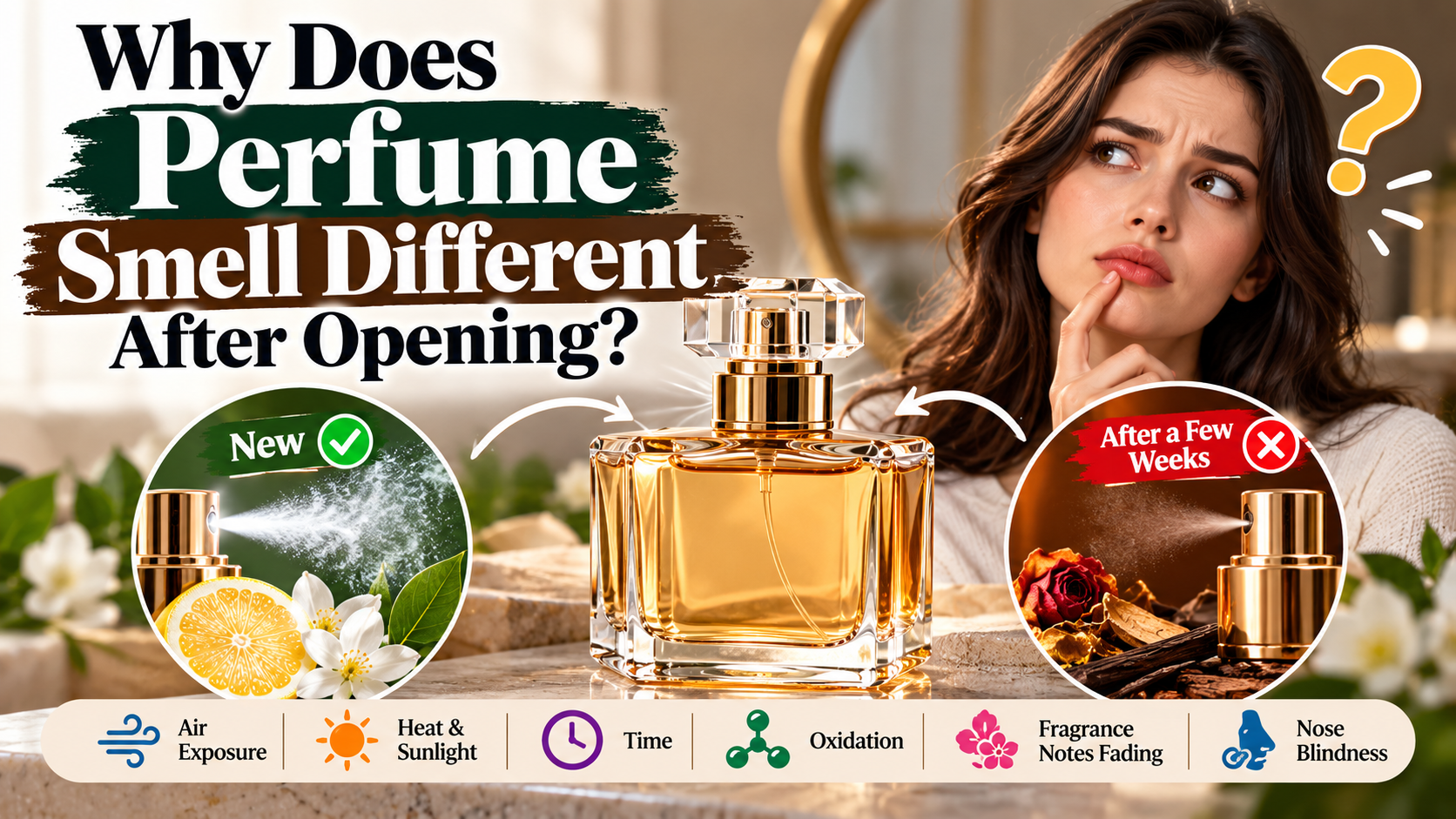
Perfume can smell different after opening because its fragrance develops on your skin, its ingredients react with air over time, and heat or sunlight may affect the liquid. Sometimes, the change is completely normal. In other cases, it may be a sign that the fragrance has started to deteriorate.
If you have noticed a change and wondered why does perfume lose its smell, the first step is to check when the difference occurs. A fragrance that smells weaker after a few hours may simply be drying down, while a perfume that smells sour or unusually sharp straight from the bottle may need closer attention.
This guide explains why perfume changes smell after opening, what affects its scent, how to recognise possible spoilage, and how to protect your fragrance for longer.
Why Does Perfume Smell Different Over Time?
Perfume does not smell exactly the same from the moment you spray it until the end of the day. Fragrances contain different perfume ingredients, and these evaporate at different rates. This natural process creates the changing scent you experience after application.
Most fragrances develop through three stages:
- Top notes: These are the first scents you notice. Citrus, fresh herbs and light fruity notes often appear here. They usually fade first.
- Heart notes: These emerge as the top notes become less noticeable. Floral, spicy and aromatic notes often form the heart of a fragrance.
- Base notes: These develop more clearly later. Woods, musk, amber and vanilla can help give a perfume depth and lasting power.
This process is known as the fragrance dry-down. It explains many perfume scent changes that happen during normal wear.
For example, a perfume may smell fresh and lemony when first sprayed, then become warmer and woodier after an hour. That does not automatically mean the fragrance has gone bad. It may simply be moving from its top notes to its heart and base notes.
If you are asking why does perfume smell different over time, consider whether the change happens gradually after spraying or whether the liquid itself smells noticeably different inside the bottle. This distinction can help you understand what is happening.
Why Does Perfume Smell Weaker After a Few Hours?
One common reason why does perfume smell weaker is that your nose becomes less aware of a scent after continuous exposure. This is called olfactory adaptation. You may stop noticing your perfume even though people nearby can still smell it.
Other factors can affect how long a fragrance remains noticeable:
- Fragrance concentration: Eau de parfum, eau de toilette and lighter fragrance types have different formulations. However, concentration alone does not determine how long a perfume lasts.
- Skin type and condition: Dry skin may not hold a fragrance as noticeably as well-moisturised skin. Individual skin chemistry can also influence how a perfume develops.
- Weather: Heat can make a fragrance feel stronger at first, while wind and outdoor activity may make it less noticeable.
- Application: Spraying too little may make a scent harder to detect. Rubbing the skin after application can also disturb how the fragrance develops.
- Fragrance composition: Fresh citrus notes often fade sooner than heavier woody, musky or resinous notes.
These are important factors that affect perfume longevity. A fragrance becoming less noticeable on your skin does not necessarily mean the bottle has lost its quality.
To check, take a short break from smelling the perfume. You can also ask someone you trust whether the scent is still noticeable, rather than repeatedly spraying more. For practical application advice, read Aromora’s guide on how to apply perfume.
Can Perfume Lose Its Scent Inside the Bottle?
Yes. A fragrance can change while stored, particularly if it is repeatedly exposed to air, heat or light. However, the speed and extent of these changes depend on the formula, packaging and storage conditions.
The key processes include oxidation and evaporation.
What Is Perfume Oxidation?
Perfume oxidation happens when certain fragrance ingredients react with oxygen. Over time, this can affect the original scent and may create a different smell.
Understanding how oxidation affects fragrance helps explain why a perfume that once smelled bright and fresh may later seem dull, sharp or less balanced. Not every change is caused by oxidation, and a change in colour alone cannot confirm that a fragrance has spoiled.
How Does Air Exposure Change Perfume?
Each time you open or spray a bottle, its contents may come into contact with air. Good packaging helps limit this exposure, but it cannot always prevent it completely.
Repeating how air exposure changes perfume is an important consideration when storing an opened bottle. Keeping the cap secure and closing the bottle properly after use can help reduce unnecessary exposure.
Evaporation can also affect a fragrance if the bottle does not close properly. In some cases, the balance between its more volatile and less volatile components may change.
| Possible cause | What you may notice | What to do |
| Oxidation | A sour, sharp or noticeably altered scent | Compare it with your memory of the original fragrance |
| Poorly closed cap | The scent may seem weaker or different over time | Close the bottle securely after every use |
| Heat exposure | The fragrance may develop an unusual smell | Store it in a cooler, stable environment |
| Light exposure | Colour or scent may change | Keep the bottle away from direct sunlight |
These signs can help guide your next step, but no single change proves that oxidation or spoilage has occurred.
How Heat, Sunlight and Storage Affect Perfume
Poor perfume storage conditions can affect the quality of a fragrance. High temperatures, direct sunlight and repeated temperature changes may speed up unwanted changes in some ingredients.
For this reason, perfume storage temperature matters. A perfume kept on a sunny windowsill or beside a radiator may face more heat and light than one stored in a cool, dark cupboard.
Follow these simple habits to protect your fragrance:
- Keep perfume away from direct sunlight. A bedroom shelf near a sunny window is not an ideal place.
- Avoid heat sources. Do not store fragrance beside radiators or in a hot car.
- Choose a cool, dry place. A cupboard or drawer away from temperature changes is usually a better option than a bathroom exposed to regular steam.
- Close the cap properly. This helps limit air exposure and reduces the risk of leaks.
- Keep the original bottle. It is designed to hold the fragrance, so transferring the liquid into another container may introduce unnecessary air or contamination.
- Avoid frequent temperature changes. A stable environment is generally preferable to moving the bottle between hot and cold places.
If you want to learn more, see Aromora’s guide to temperature effects on perfume.
Following these ways to preserve perfume fragrance can help protect its original character. Good storage cannot stop every change, but it can reduce avoidable exposure to conditions that may affect the scent.
How to Tell If Perfume Has Gone Bad
Knowing how to tell if perfume has gone bad can help you distinguish ordinary fragrance development from possible deterioration. Look at the scent, appearance and condition of the bottle together rather than relying on one sign.
Signs of Possible Perfume Deterioration
Pay attention to these changes:
- A strong, unusual smell: The fragrance smells sour, rancid or sharply different from how you remember it.
- A lasting change in scent: The unusual smell remains when you test a small amount, rather than disappearing as the top notes fade.
- A noticeable change in appearance: The liquid has become much darker or looks different from before. This is a clue, not proof, because some perfumes naturally change colour.
- A damaged or leaking bottle: A faulty cap or seal may allow air to enter or liquid to escape.
- A combination of changes: An unusual smell alongside a clear change in appearance or a damaged bottle deserves more attention than any one sign alone.
These may be signs of expired perfume, but they are not definitive tests. Some fragrances naturally deepen in colour or smell different after application. If the perfume develops a strongly unpleasant or unexpected scent, stop using it rather than trying to cover the change with other products.
For more information about shelf life and warning signs, read Does Perfume Expire? Signs Your Fragrance Has Gone Bad.
Perfume Fading vs Expiring: What Is the Difference?
The difference between perfume fading and expiring comes down to the type of change you notice.
| Perfume fading | Possible deterioration |
| The scent becomes less noticeable on your skin | The scent smells clearly different or unpleasant |
| Top notes fade as the fragrance develops | The smell may remain unusual from the first spray |
| You may stop noticing the scent because of olfactory adaptation | The liquid may also show changes in colour or appearance |
| The perfume may still smell normal on a fresh application | Several warning signs may appear together |
A perfume that becomes softer during the day is not necessarily spoiled. Equally, a fragrance that smells unpleasant straight from the bottle should not be dismissed as normal dry-down.
How Long Does Perfume Last After Opening?
Perfume shelf life varies. It depends on the ingredients, formula, packaging, storage conditions and how the bottle is handled. There is no single expiry period that applies to every fragrance.
Some bottles remain enjoyable for years when stored well, while others may change sooner. Check the product packaging for any guidance from the manufacturer, including an open-jar symbol where one is provided.
If you want to know why does perfume lose its scent, remember that a weaker smell on your skin is not the same as a fragrance deteriorating inside its bottle. Before replacing a perfume, consider its storage history and check whether the liquid itself has developed an unusual scent.
What Should You Do If Your Perfume Smells Different?
If your fragrance no longer smells as expected, follow these steps:
- Test it again carefully. Spray a small amount onto a fragrance strip or clean skin and allow it time to develop.
- Check the timing. If the change happens gradually after spraying, it may be a normal dry-down. If the scent is unusual from the first spray, investigate further.
- Review its storage. Think about whether the bottle has been exposed to sunlight, heat or repeated temperature changes.
- Inspect the bottle. Check that the cap closes properly and look for leaks or obvious changes in the liquid.
- Compare the scent. If possible, compare it with a trusted sample of the same fragrance. Differences between batches can occur, so a comparison is not always conclusive.
- Stop using it if the smell is strongly unpleasant. Do not rely on storage changes to restore a fragrance that has already deteriorated.
At Aromora, fragrance advice should help you make an informed decision rather than encourage you to replace a perfume unnecessarily. If the scent simply develops differently on your skin, you may not need to do anything. If several warning signs appear together, treating the bottle with caution is the sensible choice.
How to Keep Your Perfume Smelling Its Best
A perfume smelling different does not always mean it has gone bad. Fragrances naturally develop from top notes to heart and base notes, and your nose may become less aware of a scent after wearing it for a while. Changes inside the bottle can also happen, especially when storage conditions are poor.
Pay attention to when the change occurs, check the liquid and bottle, and store your fragrance carefully. These simple habits can help you understand your perfume better and make it easier to decide when a change is normal and when it may be time to stop using it.
For more fragrance guidance, explore the informational guides at Aromora and follow the care advice provided with your perfume.
Frequently Asked Questions
Why does perfume smell different after opening?
Perfume may smell different after opening because ingredients can react with air, while heat, light and storage conditions may affect the formula. Normal changes can also occur as the fragrance develops on your skin. A gradual change during wear is not the same as an unusual smell coming directly from the bottle.
Can perfume go bad if it is stored properly?
Yes. Proper storage can reduce avoidable damage, but it cannot guarantee that a perfume will remain unchanged forever. The formula, ingredients, packaging and age of the fragrance all influence how it develops over time.
Does a darker perfume mean it has expired?
Not always. Some fragrances naturally become darker as they age, and colour changes alone do not confirm spoilage. Consider the scent, the bottle’s condition and any manufacturer guidance before deciding whether the perfume is still suitable to use.
How should I store perfume to protect its scent?
To learn how to store perfume properly, keep it in its original bottle, close the cap securely, and choose a cool, dry place away from direct sunlight and heat. Avoid bathrooms with frequent steam and places where temperatures change often.