



Blog
How Does Temperature Affect Perfume Performance?

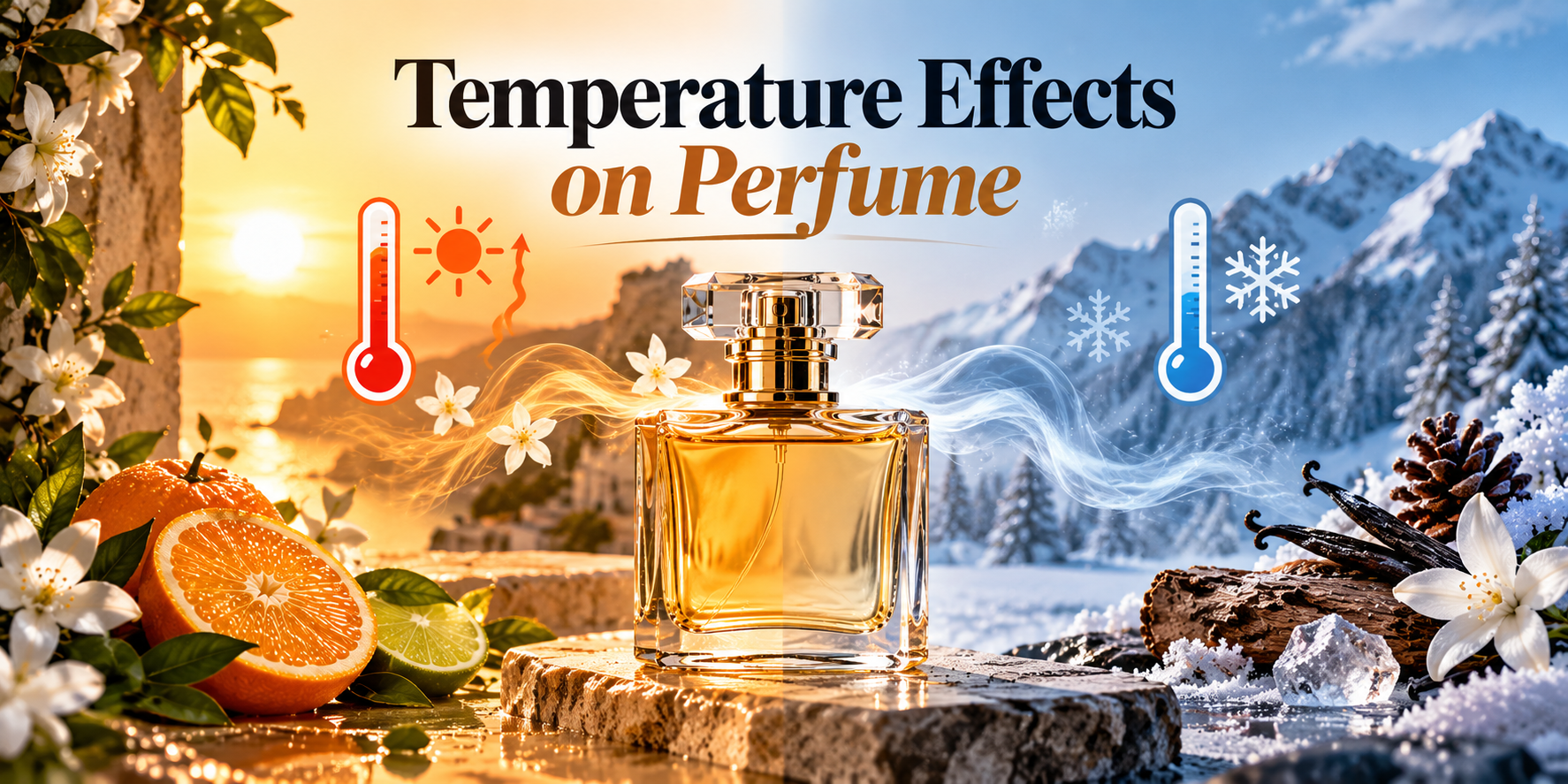
Have you ever noticed that your perfume smells strong when you first spray it but fades before the end of the day? Or does your favourite fragrance smell different during summer and winter? Temperature can change how a perfume smells, how quickly its scent develops and how far it travels from your skin.
The main reason is evaporation. Perfume contains aromatic ingredients that release into the air, allowing you to smell them. Warm conditions can speed up this process, while cooler conditions may slow it down. However, the result depends on the fragrance formula, your skin, humidity and where you wear the perfume.
If you understand these changes, you can choose a suitable fragrance for the weather, apply it more wisely and protect your bottles from damage.
How Does Temperature Affect Perfume Performance?
Temperature affects perfume in two different ways: it changes how the fragrance behaves after you spray it, and it can affect the quality of the liquid while you store it.
On your skin, warmth can make a fragrance develop faster and smell stronger at first. The scent may also become less noticeable sooner. In cooler conditions, a perfume may develop more slowly and stay closer to your body.
Inside the bottle, long-term exposure to excessive heat can change the fragrance’s original smell. This is why storing perfume correctly matters just as much as choosing the right scent.
| Condition | What you may notice | What you can do |
| Hot summer day | Stronger opening, faster scent changes | Start with fewer sprays |
| Cold winter day | Softer projection or slower development | Give the fragrance time to settle |
| Hot car | Risk of changes to fragrance quality | Never leave your bottle inside |
| Sunny windowsill | Heat and light exposure | Move it to a dark cupboard |
| Dry skin | Fragrance may seem to fade sooner | Try an unscented moisturiser |
| Humid weather | Some fragrances may feel heavier | Choose a scent that feels comfortable |
These are general patterns, not guarantees. Two perfumes can behave very differently in the same weather.
Perfume in Hot Weather: Why Does It Smell Different?
Hot weather can change your perfume within minutes of application. When your skin and the surrounding air become warmer, some fragrance ingredients evaporate more quickly. This can make the opening smell bright and powerful before the scent changes.
For example, a citrus fragrance may give you a sharp burst of lemon or bergamot when you first spray it. After some time, those fresh notes may become less noticeable, allowing the heart and base notes to stand out.
A warm day can also make a sweet or spicy perfume feel heavier. If you apply several sprays before travelling on a hot train or entering a warm office, the fragrance may become stronger than you expected.
Why Does Perfume Sometimes Fade Faster in Summer?
Several factors can explain this:
- Faster evaporation: Some aromatic ingredients leave the skin more quickly in warm conditions.
- Sweating: Sweat can mix with fragrance and change the way you experience its smell.
- Sun exposure: Spending time outdoors can expose both your skin and perfume bottle to heat and sunlight.
- Dry skin: Skin that lacks moisture may not hold certain fragrances as well as moisturised skin.
- Moving air: Wind and ventilation can carry fragrance away from your body.
Do not assume that every summer perfume will last only a few hours. Longevity depends on the formula, concentration, application and environment. A fragrance that fades quickly on one person may last longer on another.
Which Perfume Notes Work Well in Summer?
When the weather is warm, many people prefer fresh, clean and lighter-smelling fragrances.
Citrus notes such as lemon, grapefruit, mandarin and bergamot give a perfume a bright opening.
Aquatic notes create a fresh, water-inspired character that many people enjoy during summer.
Green notes such as leafy accords and fresh herbs can smell crisp and natural.
Light floral notes such as neroli and jasmine can add softness without making the fragrance feel too sweet.
Fresh aromatic notes such as lavender and mint can give a perfume a clean, herbal character.
These are suggestions rather than rules. You can wear a sweet, woody or spicy fragrance in summer if you enjoy it. The key is to consider how strong it feels in the heat and how much you apply.
How to Wear Perfume in Hot Weather
Try these simple steps when temperatures rise:
- Apply one or two sprays first rather than using the same amount you would in winter.
- Use an unscented moisturiser if your skin tends to feel dry.
- Apply perfume to clean, dry skin and allow it to settle naturally.
- Avoid spraying perfume onto sunburnt or irritated skin.
- Test your fragrance before wearing it to a long outdoor event.
- Reapply only when needed and follow the product’s instructions.
A useful tip is to test your perfume before leaving home. If it smells strong after 15–30 minutes, you may not need another spray.
Perfume in Cold Weather: Does Cold Make Fragrance Last Longer?
Cold weather can slow the evaporation of some fragrance ingredients. As a result, your perfume may develop more slowly or feel less noticeable during the first part of wear.
This can make people think their fragrance has stopped working. In reality, the scent may simply be developing at a different pace.
For example, a woody perfume with cedarwood, musk and amber accords may feel quiet when you first step outside on a cold morning. After you spend some time indoors, the fragrance may become easier to notice.
However, cold weather does not guarantee longer-lasting perfume. Your skin condition, the perfume’s ingredients and the environment still matter.
Why Does Perfume Smell Weaker in Winter?
Cold air and cooler skin can change how quickly fragrance molecules move into the air. When fewer scent molecules reach your nose at once, the perfume may seem weaker.
Indoor heating can add another challenge. Heated rooms may have dry air, which can leave your skin feeling less comfortable and affect how a fragrance wears.
Before adding more sprays, give your perfume time to develop. You may find that it smells more noticeable after you move into a warmer environment.
Which Perfume Notes Suit Winter?
Many people enjoy deeper and warmer fragrance styles during colder months.
- Woody notes: Cedarwood, sandalwood and vetiver provide an earthy character.
- Amber accords: These often give fragrances a warm, rich feel.
- Spicy notes: Cardamom, cinnamon and pepper add warmth and depth.
- Gourmand notes: Vanilla and tonka bean can create a sweet, comforting scent.
- Musky notes: Musk can add softness and help create a smooth fragrance profile.
The fragrance’s full formula matters more than any single note. A fresh woody perfume can work well in winter, just as a rich amber fragrance can suit a cool summer evening.
How to Wear Perfume in Winter
You do not need to spray more perfume simply because the weather is cold.
- Apply your fragrance to clean, moisturised skin.
- Give it time to develop before deciding whether it needs another spray.
- Test the scent both indoors and outdoors.
- Avoid rubbing your wrists together after application.
- Choose a fragrance that suits the setting, whether you are at work, travelling or attending an evening event.
If you wear perfume in an office, remember that a scent which feels subtle to you may be more noticeable to someone sitting nearby.
Does Heat Affect Perfume Quality?
Yes. Excessive heat can affect the quality of perfume over time, especially when you leave the bottle in a hot or sunny place for long periods.
Perfume contains a mixture of aromatic ingredients and usually alcohol. These ingredients can undergo chemical changes as they age. Heat and light can speed up some of these changes, which may alter the fragrance’s smell or appearance.
It is important to understand the difference between perfume performance and perfume quality. A fragrance may smell different on your skin because of the weather, even when the liquid inside the bottle remains in good condition. A bottle exposed to repeated high temperatures, however, may develop a lasting change in its original scent.
How Can You Tell If Heat Has Changed Your Perfume?
Look for changes from the fragrance’s normal condition.
- A different smell: The perfume may develop an unusual sour, stale or unpleasant smell.
- A change in colour: The liquid may darken over time, although some fragrances naturally change colour with age.
- A different scent profile: The perfume may lose some of its familiar freshness or smell noticeably different.
- A history of poor storage: The bottle has spent a long time in direct sunlight, near a heater or inside a hot car.
One sign alone does not always mean that a perfume has spoiled. Some fragrances naturally darken with age. If the smell has changed significantly, check the manufacturer’s advice before deciding whether to keep using it.
Does Cold Affect Perfume?
Cold conditions can affect a perfume’s appearance, but ordinary winter temperatures do not automatically damage a fragrance.
Some ingredients may become cloudy or form small deposits when the liquid gets very cold. In certain cases, the appearance returns to normal after the bottle gradually warms to room temperature.
Avoid placing your perfume in a freezer to improve its performance. Freezing does not make a fragrance last longer on your skin, and extreme or repeated temperature changes are unnecessary.
If your perfume has become cloudy after exposure to cold, let it return gradually to room temperature. Check its appearance and smell before using it again, and follow any storage advice from the manufacturer.
What Is the Best Temperature for Perfume?
For most perfumes, a cool and stable room is a practical choice for storage. There is no single exact temperature that suits every formula, but avoiding excessive heat, direct sunlight and repeated temperature changes is more important than chasing a precise number.
A bedroom drawer or closed wardrobe is often a better place than a bathroom shelf or sunny windowsill.
Where Should You Store Perfume?
| Place | Is it suitable? | Why |
| Closed bedroom drawer | Yes, usually | Protects the bottle from light |
| Cool wardrobe | Yes, usually | Offers a stable, dark space |
| Bathroom shelf | Usually not | Showers cause heat and humidity changes |
| Sunny windowsill | No | Direct sunlight can heat the bottle |
| Car dashboard | No | Parked cars can become extremely hot |
| Near a radiator | No | Prolonged heat can affect fragrance quality |
How to Store Perfume Properly
- Keep it away from sunlight
Store your bottle in a drawer, cupboard or its original box. Direct sunlight can heat the liquid and affect some fragrance ingredients.
- Close the bottle after every use
Replace the cap securely and make sure the spray mechanism is in good condition. Limiting unnecessary exposure to air can help protect the fragrance over time.
- Avoid frequent temperature changes
Do not keep moving your perfume between a hot room, a cold car and a refrigerator. A steady environment is more practical for everyday storage.
- Choose a dry location
A bedroom cupboard is often a better option than a bathroom, where steam and temperature changes occur frequently.
- Follow the manufacturer’s guidance
Different fragrance formulas may have different storage needs. Check the product label or the manufacturer’s instructions if you are unsure.
Temperature and Fragrance Performance: Other Factors to Consider
Temperature is only one part of the story. How temperature affects perfumes If your perfume smells different from one day to the next, other factors may explain the change.
Fragrance Concentration
Eau de Toilette, Eau de Parfum and Parfum are different fragrance categories, generally linked to differences in fragrance concentration. However, there is no universal rule that a higher concentration always means better projection or longer wear.
The ingredients and formula play an important role. A well-made Eau de Toilette may last longer on your skin than a particular Eau de Parfum.
Top, Heart and Base Notes
Perfumes often develop in stages.
Top notes create the first impression. Citrus and some fresh ingredients are common examples.
Heart notes form the main character as the opening fades. Floral, aromatic and spicy notes often feature here.
Base notes help shape the later stages of the scent. Woods, musks, resins and vanilla are common examples.
These stages are not strict time slots. Ingredients can overlap, and each perfume develops in its own way. Warm conditions may speed up the development of some ingredients, while cooler conditions may slow it down.
Skin Hydration
Dry skin can affect how some fragrances wear. Applying an unscented moisturiser before perfume may help the scent remain noticeable for longer, although results differ between people.
Humidity and Airflow
Humidity can change how a fragrance feels in the air, especially during warm weather. Some sweet or heavy scents may feel stronger in humid conditions.
Airflow also matters. Wind and ventilation can carry fragrance away, while a still, enclosed room can allow a scent to build up around you.
Clothing and Application
Some fabrics can hold fragrance differently from skin. If you apply perfume to clothing, check the care label and test a small, hidden area first. Some fragrances can stain delicate or light-coloured fabrics.
Do not apply more perfume just because you cannot smell it on yourself. Your nose can become used to a scent after wearing it for a while, even when other people can still notice it.
How to Test Your Perfume in Different Temperatures
If you want to find out how your favourite fragrance performs, you can run a simple test at home.
Step 1: Start with clean skin. Use the same area of skin each time and avoid applying another scented product.
Step 2: Use the same number of sprays. This helps you compare results fairly.
Step 3: Test under different conditions. Notice how the perfume smells in a cool indoor space and on a warmer day. Avoid deliberately exposing the bottle to extreme temperatures.
Step 4: Check at regular intervals. Notice the scent after application, then again after around one hour, three hours and later in the day.
Step 5: Record what you notice. Write down whether the fragrance feels strong, soft, fresh, sweet or woody at each stage.
Step 6: Repeat the test. One day’s results may be affected by humidity, activity, skin condition or other factors.
This method will not give you a laboratory measurement, but it can help you understand how the fragrance suits your routine.
Frequently Asked Questions
Will perfume get ruined when in hot temperature?
Excessive heat can change a perfume’s smell and quality over time. A short period in a warm room does not automatically ruin it, but prolonged exposure to high temperatures can speed up unwanted changes. Store perfume in a cool, dark place and never leave it in a hot car.
What is the 3:1:1 rule for perfume?
The 3:1:1 rule is not a universally recognised standard for perfume storage or application. Its meaning depends on the source using it. Check the original explanation before following it, rather than treating it as an established fragrance rule.
What is the 30/50/20 rule for perfume?
The 30/50/20 rule does not have one widely established meaning in perfume care. Without a reliable source defining it, it should not be presented as a proven method for improving fragrance performance.
How do I make my perfume smell stronger and last longer?
Apply perfume to clean, moisturised skin, use a suitable amount and store the bottle away from heat and sunlight. Choose a fragrance that suits your needs and allow it to develop before reapplying. Remember that stronger projection does not always mean better performance.
Does perfume last longer in winter or summer?
Some perfumes may last longer on the skin in cooler weather because evaporation can slow down. However, this is not true for every fragrance. The formula, concentration, skin condition and environment all affect longevity.
Should I keep my perfume in the fridge?
Most perfumes do not need to be refrigerated. A cool, dark cupboard is generally sufficient. Repeatedly moving a bottle between a cold fridge and a warm room can create unnecessary temperature changes. Follow the manufacturer’s storage instructions if they recommend something different.
Can I wear the same perfume all year?
Yes. You can wear the same fragrance throughout the year if you enjoy it. You may choose to use fewer sprays during warm weather or adjust your application for different settings, but there is no rule that requires a separate perfume for every season.
Final Thoughts
Temperature can change how quickly your perfume develops, how noticeable it feels and how well it keeps its original smell during storage. Warm weather may make a fragrance stronger at first, while cold conditions can slow its development. Neither condition guarantees a specific number of hours of wear.
The best approach is simple: choose a fragrance you enjoy, adjust the number of sprays to suit the weather, moisturise dry skin and store your bottle away from excessive heat and sunlight.
At Aromora, we believe that understanding your fragrance helps you enjoy it with confidence throughout the year. A few sensible habits can help you get more from your favourite scent while keeping your perfume in better condition.